



In commercial design projects, whether you’re planning educational spaces design, hospital design, office design, or coordinating with furniture manufacturers on integrated power systems, electrical specifications cannot be an afterthought. Selecting the correct ratings affects safety, performance, code compliance, and long-term operational efficiency.
This guide breaks down the core units of measurement in electricity, what they represent, and how to determine appropriate levels for different environments and devices, from legacy fluorescent lighting to modern LED fixtures, laptops, and integrated power in furniture systems.
-
Voltage (V) – The Electrical Pressure
Voltage, measured in volts (V), represents electrical potential difference. Think of it as the “pressure” that pushes current through a conductor.
Common Voltage Levels in the US
- 120V – Standard receptacles (offices, classrooms, residential)
- 208V – Common in commercial buildings (3-phase systems)
- 240V – Larger equipment, some residential appliances
- 277V – Commercial lighting circuits
- 480V – Industrial and large mechanical equipment
What Designers Should Consider
- Office design & educational spaces design: 120V receptacles are standard for laptops, monitors, and charging stations.
- Hospital design: Often includes redundant power systems and isolated grounding; voltage consistency is critical for sensitive medical equipment.
- Commercial lighting retrofits: Many legacy fluorescent systems operate at 277V; newer LED drivers often support 120–277V universal input.
Key takeaway: Match the building’s electrical distribution system to your specified equipment. Confirm whether fixtures and power modules are rated for the building’s available voltage.
-
Current (Amperage, A) – The Flow Rate
Current, measured in amperes (A), indicates how much electricity is flowing.
Typical Circuit Ratings
- 15A circuits – Standard office and classroom receptacles
- 20A circuits – Higher-demand commercial environments
- 30A+ circuits – Specialized equipment
Why It Matters
Circuit breakers are rated in amps. Exceeding that rating trips the breaker.
Example:
A 15A circuit at 120V can supply:
120V × 15A = 1,800 watts (max theoretical)
For safety (80% rule per NEC continuous load guidelines), usable continuous load is:
1,800W × 0.8 = 1,440W
In office design and furniture-integrated power systems, understanding amperage ensures you don’t overload a workstation cluster with monitors, task lighting, docking stations, and personal devices.
-
Watt (W) – The Power Consumption
Watts (W) measure real power, how much energy a device actually uses.
Formula: Watts = Volts × Amps
This is the most practical unit for specifying fixtures, power docks, and device loads.
Lighting Example: Older vs. LED
|
Fixture Type |
Typical Wattage |
Light Output |
|
Incandescent |
60W |
~800 lumens |
|
Fluorescent |
32W |
~2,800 lumens |
|
LED |
8 – 15W |
~800 – 1,600 lumens |
In commercial design projects, LED lighting dramatically reduces wattage requirements, lowering circuit demand and long-term energy costs, especially critical in educational facilities and hospital environments that operate extended hours.
-
Kilowatt (kW) & Kilowatt-Hour (kWh) – Capacity and Energy Use
- Kilowatt (kW) = 1,000 watts (rate of power use)
- Kilowatt-hour (kWh) = Energy consumed over time
If a 100W fixture runs for 10 hours:
100W × 10 hours = 1,000Wh = 1 kWh
In large-scale commercial interiors, understanding kWh helps facility managers evaluate operational costs and sustainability benchmarks.
-
Volt-Amps (VA) – Apparent Power (Critical in Commercial Environments)
In systems with motors, transformers, or electronic drivers, you’ll often see VA instead of watts.
Formula: VA = Volts × Amps
Because of power factor (PF), watts may be lower than VA:
Formula: Watts = VA × Power Factor
This is particularly relevant when specifying:
- LED drivers
- Power supplies for integrated furniture
- Hospital equipment
- Server and IT infrastructure
In office design and healthcare facilities, power factor correction impacts efficiency and panel capacity planning.
-
Hertz (Hz) – Frequency
In the US, standard frequency is 60 Hz.
Most commercial equipment is designed for this frequency. It’s rarely a design concern unless specifying imported equipment.
How to Determine Appropriate Ratings by Environment
-
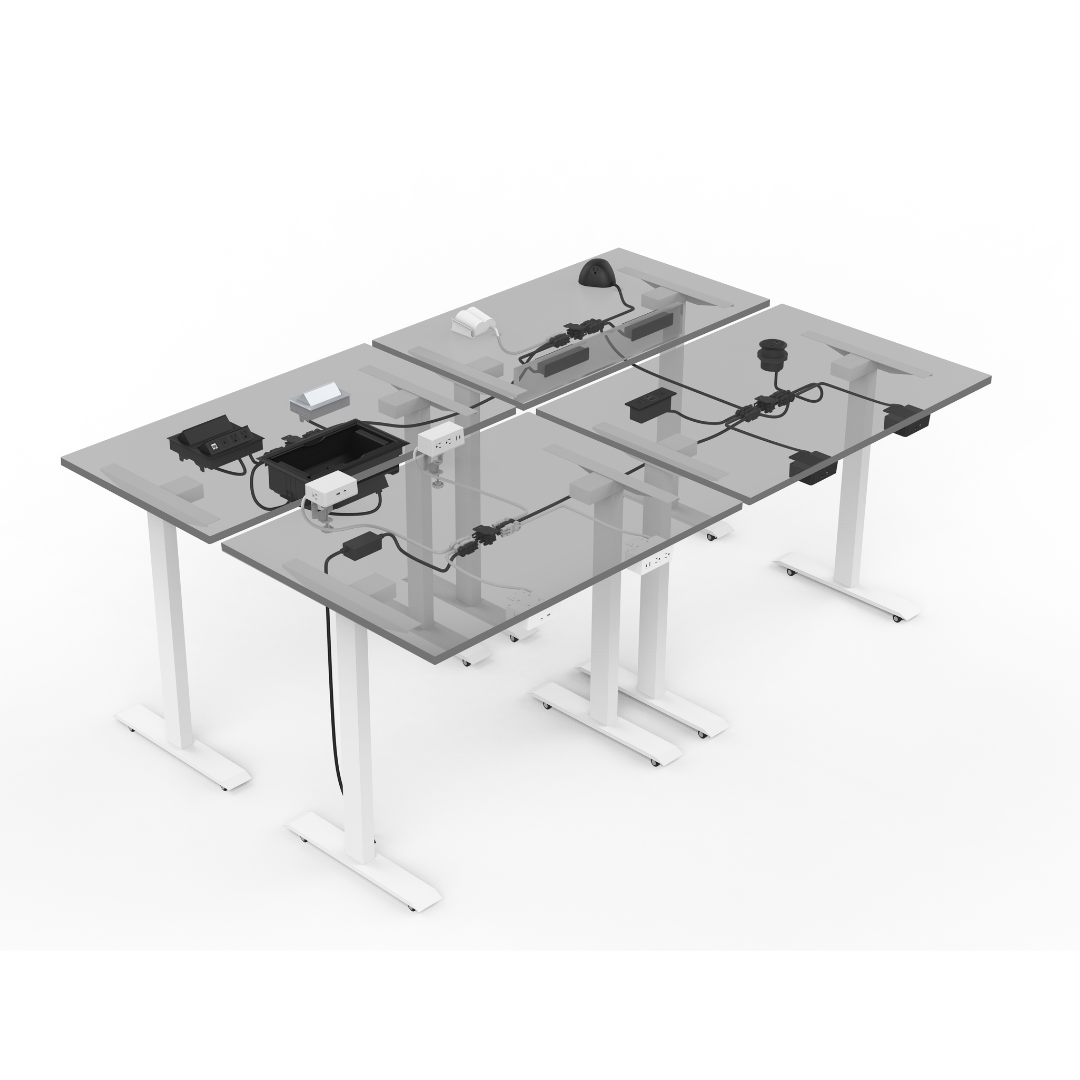
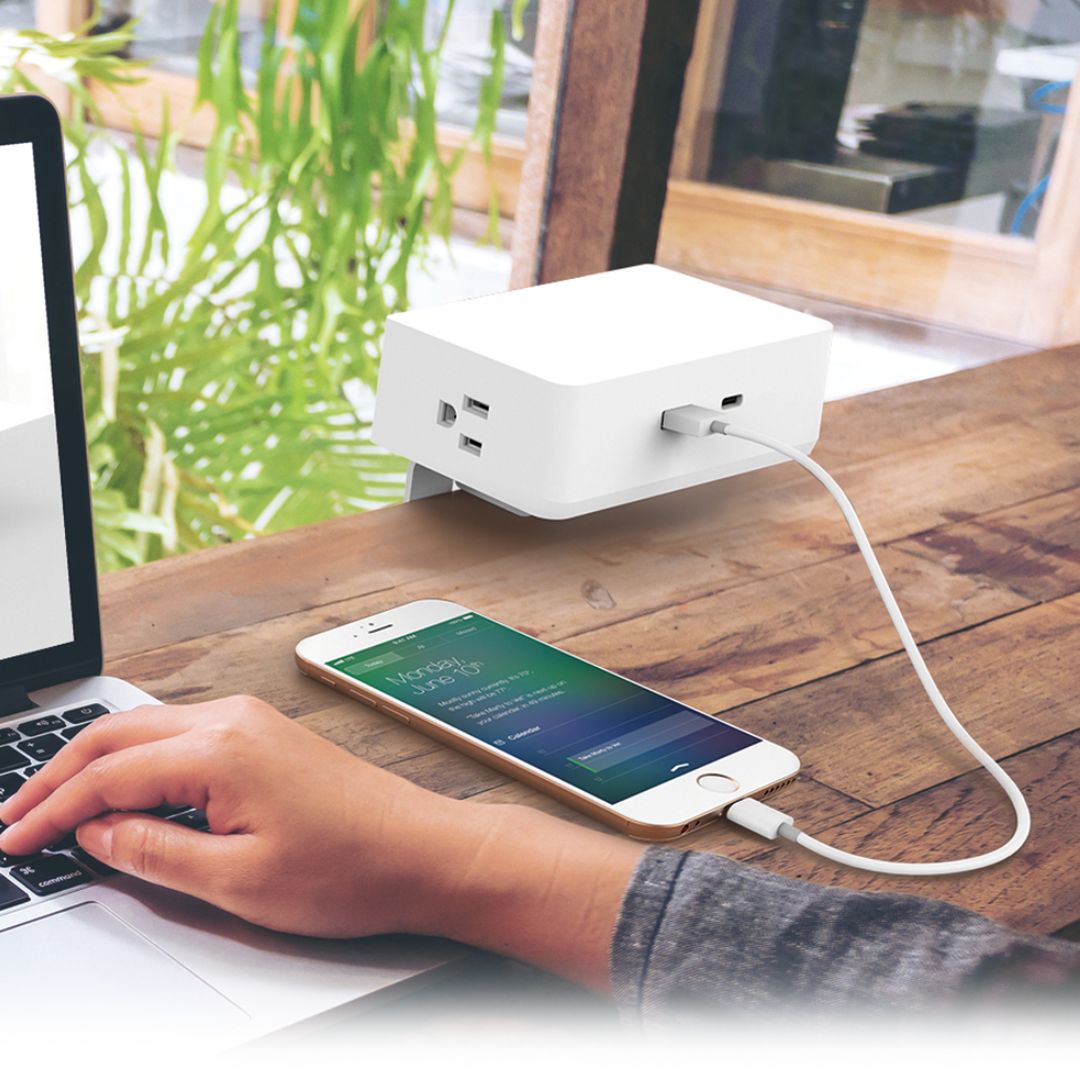
Office Design & Furniture-Integrated Power
Modern workstations typically power:
- Laptop: 45–100W
- Monitor: 20–60W
- Phone charger: 5–30W
- Task lighting (LED): 5–15W
A single workstation may require 150–250W total.
For a 6-person benching system:
250W × 6 = 1,500W
That nearly reaches the safe continuous limit of a 15A circuit. This is why modular power systems for furniture manufacturers must be carefully engineered and often distributed across multiple circuits.
Recommendation:
- Specify UL-listed modular power distribution systems.
- Confirm load calculations early in commercial design projects.
-
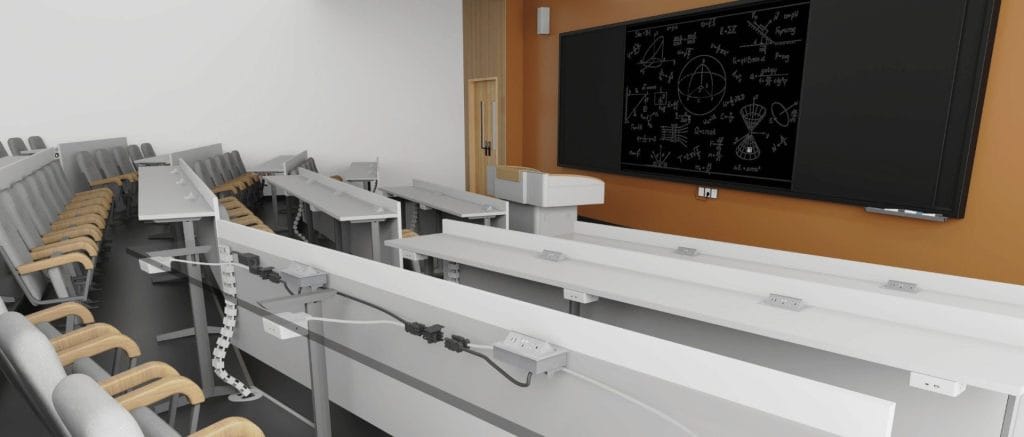
Educational Spaces Design
Classrooms increasingly include:
- Interactive displays (200–400W)
- Student device charging carts (1,200–1,800W)
- LED lighting systems
- HVAC controls
Charging carts alone can exceed a 15A circuit.
Recommendation:
- Dedicate circuits for high-density charging.
- Use surge-protected power modules.
- Plan for future device expansion.
-
Hospital Design & Healthcare Facilities
Healthcare environments demand:
- Isolated power systems
- Emergency backup integration
- Redundant circuits
- Strict NEC and NFPA compliance
Medical equipment may list ratings in:
- Watts
- VA
- Amps
Critical care areas require load calculations that account for continuous operation and redundancy.
Recommendation:
- Always consult electrical engineers for load studies.
- Verify equipment startup (inrush) current.
- Ensure compatibility with emergency power systems.
-
Lighting Retrofits (Older vs. LED)
When retrofitting from fluorescent to LED:
- The existing circuit may be rated for a higher load.
- LEDs significantly reduce amperage demand.
- Lower wattage frees capacity for additional devices.
Example:
Replacing ten 32W fluorescent fixtures: 32W × 10 = 320W
Replacing with 15W LEDs: 15W × 10 = 150W
That’s more than a 50% load reduction!
In commercial interiors and office renovations, this may allow additional integrated power without upgrading panels.
-
Residential Considerations
Residential circuits are typically:
- 15A or 20A at 120V
Most consumer electronics (phones, laptops, TVs) draw modest wattage.
However, the same principles apply: calculate total watts and respect circuit limits.
Quick Reference: Device Power Ranges
|
Device |
Typical Wattage |
|
LED desk lamp |
5–15W |
|
Laptop |
45–100W |
|
Desktop computer |
300–600W |
|
Monitor |
20–60W |
|
Phone charger |
5–30W |
|
Interactive whiteboard |
200–400W |
|
Server rack (small) |
1,000W+ |
Practical Framework for Specifying Power in Commercial Projects
- Identify voltage available in the building.
- Calculate total wattage per area or furniture cluster.
- Apply the 80% continuous load rule.
- Account for future expansion.
- Verify UL listings and code compliance.
- Coordinate early with electrical engineers.
Why This Matters for Commercial Design Professionals
In high-performance educational spaces, hospital design, office design, and collaborative environments, power access is no longer peripheral, it is infrastructure.
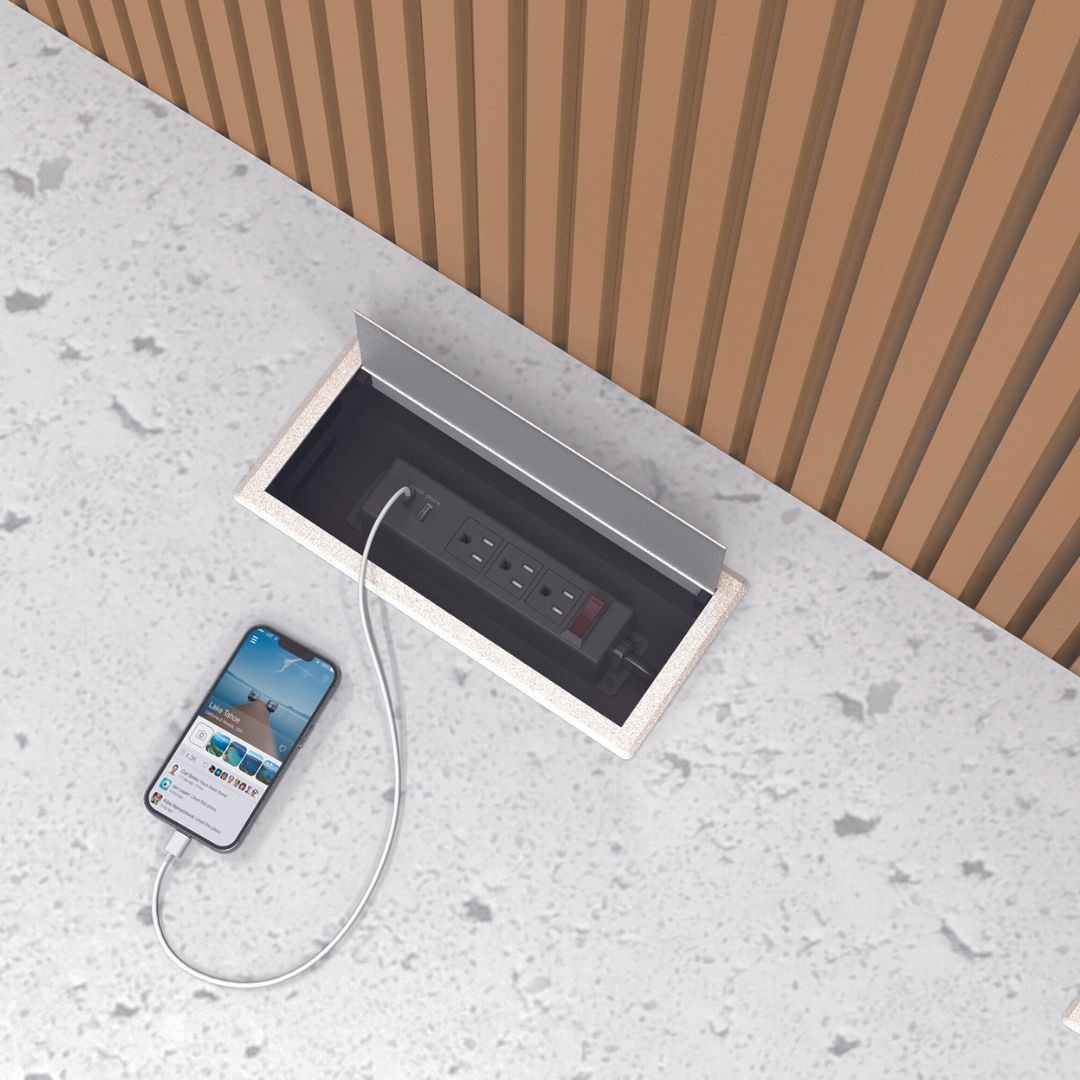
Furniture manufacturers integrating modular power docks, recessed outlets, and distributed systems must understand:
- Voltage compatibility
- Circuit amperage
- Load balancing
- Power factor
- Scalability
A well-specified electrical strategy supports:
- User safety
- Code compliance
- Energy efficiency
- Future adaptability
- Long-term operational savings
Final Thought
Electrical units, volts, amps, watts, VA, kWh, are not abstract technical jargon. They are the language of safe and effective power planning.
For commercial design projects, understanding these measurements allows architects, engineers, designers, and furniture manufacturers to specify integrated power solutions confidently, ensuring every device, fixture, and workstation performs exactly as intended without overloading circuits or compromising performance.